
The Faulty FRM Module Explained: Why Your BMW or MINI Cooper is Having Electrical Gremlins
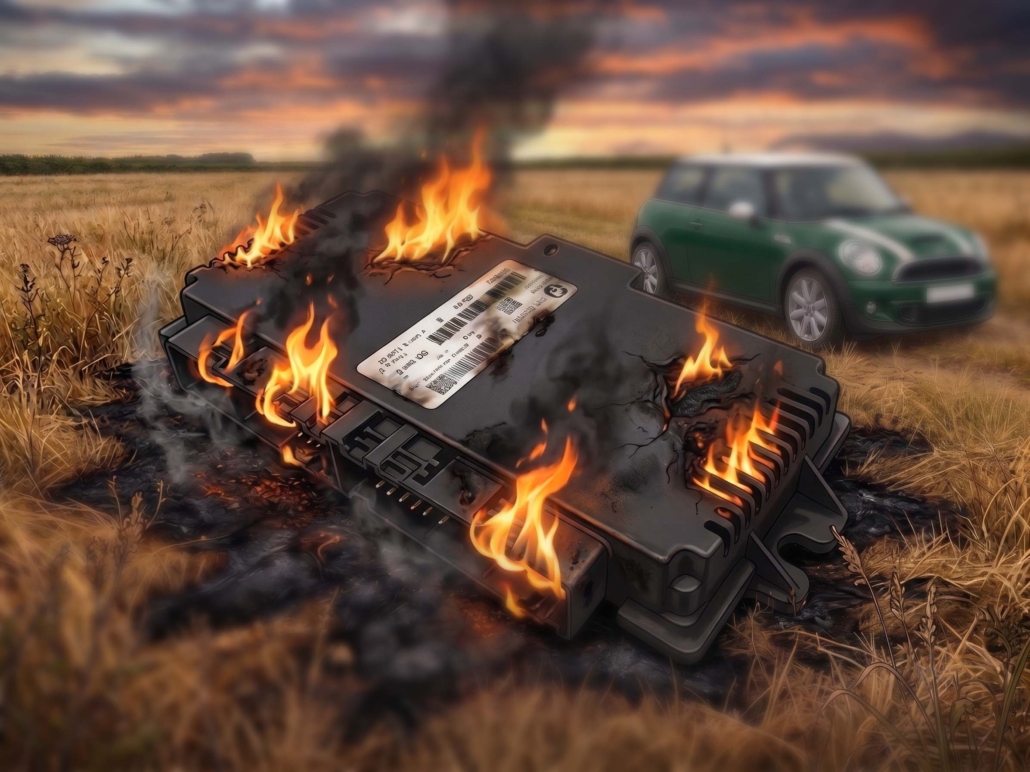
If you own a modern BMW or a MINI Cooper, it is common that you will have Faulty FRM Module in. You might eventually encounter a day where your car’s electrical system seems to completely lose its mind. For Example, these vehicles include; BMW E90 3 Series, E70 X5, or E87 1 Series or R56 & R60. Just to name a few. The turn signals stop working, the power windows refuse to roll down, and the headlights stay on permanently—even when the switch is in the “off” position.
It is entirely understandable to feel panicked and assume your vehicle has a massive, unfixable wiring short. However, the reality is usually much less dramatic. These widespread electrical failures almost always point to a single, highly sensitive component: The FRM Module.
What is the FRM (Footwell) Module?
FRM is German for ‘Fussraummodul’, which translates to “Footwell Module.” Located exactly where the name suggests (behind the plastic kick panel in the driver’s side footwell), this computer is the central command center for your vehicle’s body electronics.
The FRM is responsible for controlling:
-
Exterior lighting (headlights, taillights, turn signals, hazard lights)
-
Interior cabin and dashboard lighting
-
Power windows
-
Exterior mirror adjustments
-
Central locking mechanisms
When this module crashes, it takes all of these comfort and safety systems down with it.
Why Do FRM Modules Fail?
It is a common misconception that FRM failures are caused by severe water damage or physical trauma. While water intrusion from a clogged sunroof drain can certainly ruin an FRM, the vast majority of failures are actually software-related.
Here are the most common reasons an FRM module bricks itself:
-
Voltage Spikes and Drops: The FRM (specifically the FRM3 version) is incredibly sensitive to power fluctuations. Letting your car battery die completely, jump-starting the vehicle incorrectly, or simply disconnecting the battery for routine maintenance can corrupt the module’s EEPROM (its internal software memory).
-
Routine Diagnostic Scanning: Ironically, the act of trying to fix the car can sometimes break the FRM. Plugging in an OBD-II scanner to read or clear routine fault codes can push a fragile FRM over the edge, causing its software partition to collapse and freeze.
-
Thermal Fatigue: The FRM handles significant electrical current, especially when powering halogen or HID headlights. Over thousands of heating and cooling cycles, the tiny microchips and solder joints inside the module can experience thermal fatigue and crack.
Common Symptoms of a Faulty FRM Module
When the FRM module experiences a software crash, it enters a “safe mode.” To ensure you are visible on the road at night, the module defaults to turning the headlights on permanently, but it disables almost everything else.
If your FRM has failed, you will likely experience a combination of these symptoms:
-
Headlights are stuck on and cannot be turned off.
-
Turn signals and hazard lights are completely dead.
-
Power windows stop responding (on MINIs, the windows may also fail to “drop” slightly when you open the door).
-
Interior lighting does not illuminate.
-
Side mirrors refuse to adjust.
-
No OBD Communication: A mechanic’s scan tool will fail to connect to or “talk” to the FRM.
Common FRM Fault Codes
Because a Faulty FRM Module often stops communicating with the rest of the car, you might not get error codes from the module itself. Instead, the instrument cluster or the primary computer (CAS) will throw “communication errors” complaining that the FRM has gone missing.
If a diagnostic scan is performed, these are the most common fault codes associated with a dead FRM:
-
S0114: No communication with control unit possible.
-
A3C1: Message error (FRM footwell module) receiver instrument panel.
-
A3B4: Message error (lighting state), transmitter FRM.
-
A559: Instrument panel power supply has been switched off.
-
497F: Message error (reverse gear), transmitter FRM.
-
9CBB / 9CBC / 9BCC: Short circuit faults detected (often indicating the FRM has permanently shut down a lighting circuit due to a perceived short).
The Solution: Repair vs. Replace
If you take a vehicle with a failed FRM to a dealership, the standard protocol is to quote you for a brand-new module, plus the labor to install and program it. This can easily become an incredibly expensive repair.
However, in about 90% of these cases, the physical hardware inside the FRM is perfectly fine; it is only the software that has crashed. Many independent European auto specialists and electronics rebuilders offer an FRM Bench Repair service. By connecting directly to the circuit board, professionals can rewrite the corrupted EEPROM memory partition.
This process restores the module to its exact factory condition. Because it is your original module going back into your specific car, it retains your VIN and vehicle coding, making it a plug-and-play solution that is significantly more cost-effective than buying new.
Contact Us
For more information on how to get your BMW or Mini in the shop for a FRM replacement, service, maintenance or custom work, contact us at 425-254-0627. You can also schedule an appointment or receive a quote by clicking here. Meister Werks European & Import is located one block south from The Renton Landing in Renton, WA, across the street from the former Boeing Store and at the westside of the Paccar / Kenworth plant.

Meister Werks European & Import in Renton, the leader in European automotive maintenance, repair, and customization. Offering oil changes, Mercedes Service A, B, and C, brake flush, coolant flush, alignment, brakes, and more. Contact us today! At Meister Werks our goal is to be the best solution for our customers through exceptional service and quality workmanship. Our Warranty and Policies.